114
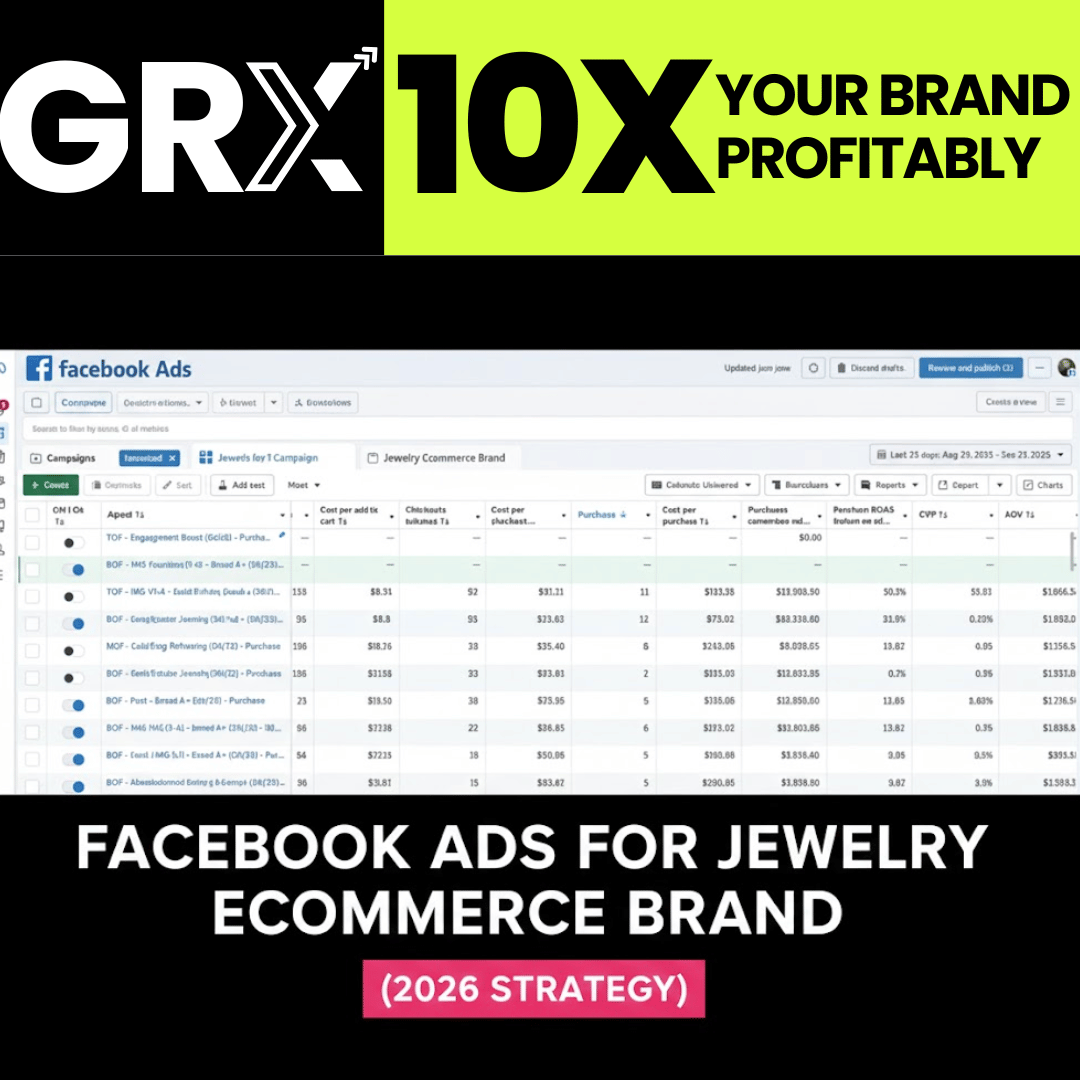
This is an in-depth walkthrough of the advertising strategy we use in our agency GRX Strategy Solutions to generate substantial cash profits for a high-ticket jewelry client in the e-commerce space. We will focus on campaign structuring, ad testing, audience targeting, and optimization tactics designed specifically for selling expensive jewelry primarily in the U.S. market. The importance of adapting campaigns to Meta’s evolving platform, leveraging different funnel stages, and carefully managing ad spend and creative variations to maintain performance over time.
This is an in-depth walkthrough of the advertising strategy we use in our agency GRX Strategy Solutions to generate substantial cash profits for a high-ticket jewelry client in the e-commerce space. We will focus on campaign structuring, ad testing, audience targeting, and optimization tactics designed specifically for selling expensive jewelry primarily in the U.S. market. The importance of adapting campaigns to Meta’s evolving platform, leveraging different funnel stages, and carefully managing ad spend and creative variations to maintain performance over time.
Key Insights and Concepts
- High-ticket jewelry advertising requires a longer decision-making cycle: Unlike lower-priced items, sales cycles can range from one week to over a month, requiring patience and sustained ad nurturing.
- Funnel segmentation is critical but customized: Nas divides campaigns into top, middle, and bottom of funnel with specific optimizations:
- Top of Funnel (TOF): Optimized for video views through “ThroughPlay” campaigns.
- Middle of Funnel (MOF): Focused on driving traffic to landing pages.
- Bottom of Funnel (BOF): Optimized for sales conversions.
- Manual ad set management over automatic CBO: Nas prefers manual ad set budget control with daily spends between $50-$80 for testing and scaling, citing better control over performance fluctuations.
- Frequent ad refresh and iteration: Ads typically perform well for 2-4 weeks before performance declines, necessitating regular new creative and angle testing.
- Meta’s algorithmic changes: The “Andromeda” update improved broad targeting performance, which was previously ineffective, allowing easier scaling with broad and interest-based targeting.
- Creative types that perform well:
- Founder-hosted videos showcasing jewelry.
- User-generated content (UGC), especially founder reviews.
- Dynamic Product Ads (DPA) with value proposition overlays.
- Testimonial videos leveraging customer reviews.
- AI-generated content (AIGC) for top-of-funnel awareness.
- Audience targeting priorities:
- Exclude existing customers to focus on new customer acquisition.
- Use lookalike audiences (3%-5%) created from purchaser data.
- Avoid “Advantage Plus” (Meta’s automated targeting) for high-ticket products; prefer narrow, refined audience segments.
- Frequency management:
- Average ad frequency of 4.5 is acceptable for luxury products, as multiple touchpoints are needed to close sales.
- High frequency too early indicates ineffective top-of-funnel ads and the need for new creatives.
- Performance tracking and metrics:
- Key metrics beyond sales include CTR, CPC, CPM, add-to-cart events, and landing page engagement.
- Use UTM parameters and Google Analytics 4 (GA4) to assess traffic quality and engagement.
- Early metrics (CTR, CPC) help judge ads before sales appear due to longer sales cycles.
- Campaign structure evolution:
- Initially focused on bottom of funnel.
- Added middle and top funnel campaigns to nurture the audience more effectively.
- Ad content layout template:
- Headline with value proposition or main offer.
- Jewelry piece image or video (new/bestselling collection).
- Brand logo.
- Value proposition points and trust signals (e.g., reviews, guarantees).
- Customer reviews are essential: At least 100 reviews recommended to boost conversion; money-back guarantees and warranties improve trust.
- Dynamic Product Ads (DPA) are highly effective for jewelry with lower CPCs despite higher CPMs.
- AI-generated videos help scale top-of-funnel traffic with engaging content, though they may appear artificial.
Timeline and Campaign Overview
| Stage | Campaign Type | Optimization Goal | Key Notes |
|---|---|---|---|
| Top of Funnel (TOF) | ThroughPlay Video Campaigns | Video Views | Use best-performing UGC and founder videos; optimize frequency; frequency ~4.5 acceptable. |
| Middle of Funnel (MOF) | Landing Page Traffic Campaigns | Website Visits | Narrow audience targeting, exclude existing customers, use refined lookalikes and interest targeting. |
| Bottom of Funnel (BOF) | Purchase Campaigns | Sales Conversions | Manual ad set budget control ($50-$80/day), constant ad refresh; test new angles and creatives. |
| Retargeting | Value Props & Testimonial Ads | Trust & Conversion | Low budget; leverage customer reviews and guarantees. |
| Broad Campaigns | Broad + Interest Targeting | Scale & Reach | Post-Andromeda update, broad targeting performs well; use combined interests for targeting. |
| Advantage Plus | Meta’s Automated Campaigns | – | Initially ineffective but improved; still recommend narrowing audience for high-ticket items. |
Quantitative Data and Metrics
| Metric | Observed Values/Comments |
|---|---|
| Revenue from Facebook Ads (2025) | Nearly $1 million (projected to exceed by year-end) |
| Daily Testing Budget per Ad Set | $50 to $80 |
| Average Cost per Checkout | Around $40 (varies by ad set performance) |
| Cost per Click (CPC) | As low as $1.8 |
| CPM | Relatively high compared to affordable jewelry brands (up to double) |
| Click-through Rate (CTR) | High on successful ads, resulting in efficient CPC |
| Ad Frequency | Average ~4.5 (acceptable for high-ticket jewelry) |
| Engagement Rate (Lookalike 3%) | 32% (considered good for average order values above $300) |
Best Practices and Recommendations
- Do not kill ads prematurely: Allow 1-4 weeks for ads selling high-ticket products to prove their value.
- Regularly test and rotate creatives: Prepare new ad angles weekly to avoid audience fatigue.
- Use manual budget controls for scaling: Rather than fully automated campaign budget optimization (CBO), manually adjust ad set budgets based on performance.
- Leverage funnel-specific metrics: Track engagement, add-to-carts, checkouts, and landing page metrics, not just immediate sales.
- Avoid broad automated targeting for expensive items: Narrow audiences with lookalikes and interests outperform broad Advantage Plus campaigns.
- Incorporate testimonials and reviews: Social proof is crucial to build trust and increase conversions.
- Try Dynamic Product Ads (DPA): Especially effective in fashion and jewelry niches, improving CPC and showcasing products dynamically.
- Use AI-generated content cautiously: Can drive top funnel traffic but should be complemented by authentic UGC.
- Track traffic quality with UTMs and GA4: Ensure that ad traffic is engaging and relevant, not just cheap clicks.
- Maintain consistent brand messaging in ads: Use a proven template including headline, product showcase, trust elements, and branding for rapid scaling of new products.
Core Concepts
- Funnel Optimization: Tailoring ads and budgets to different funnel stages (awareness, consideration, conversion).
- Creative Testing and Scaling: Introducing multiple ad variations, testing them with small budgets, and scaling winners.
- Audience Refinement and Segmentation: Excluding existing customers, focusing on lookalikes and interest targeting.
- Performance Metrics Beyond Sales: Analyzing CTR, CPC, engagement rate, frequency, and add-to-cart data.
- Importance of Trust Signals: Reviews, guarantees, and testimonials as critical conversion drivers.
- Meta Platform Adaptation: Utilizing changes in Meta’s algorithm and ad product updates (e.g., Andromeda, Advantage Plus).
Keywords
- High-ticket jewelry
- Facebook Ads
- Meta advertising
- Funnel stages (Top, Middle, Bottom)
- Dynamic Product Ads (DPA)
- User-generated content (UGC)
- AI-generated content (AIGC)
- Lookalike audience
- Manual budget control
- Ad frequency
- Customer reviews
- Cost per click (CPC)
- Click-through rate (CTR)
- Cost per purchase
- Ad creative testing
- Conversion optimization
- Engagement rate
- Meta Andromeda update
- Advantage Plus campaigns
Conclusion
This is a comprehensive, data-driven strategy for running high-performing Facebook ad campaigns for high-ticket e-commerce products, specifically jewelry. The approach balances rigorous testing, creative iteration, funnel-specific optimizations, and deep audience segmentation. Emphasizing patience in the sales cycle and leveraging multiple touch points.
You Might Also Like
- How to Create Good Converting Ads | Facebook Ads with GRX Strategy Solutions
- Celeb-approved: All the neon and bright summer outfit inspiration you need
- The BEST Facebook Ads Account Structure For Ecommerce | Facebook Ads with GRX Strategy Solutions
- Celeb fashion: Ananya Panday and Kriti Sanon party in style; check out their stunning looks